
04How it works
Four steps from load case to sample.
Every project follows the same path. Find the step you are on; that is where we start.
Set your targets.
Tell us the load case: impact energy or drop height, vibration, peak force or g limit, temperature range and the envelope the part must fit. Those numbers drive everything after.
You’re here if
You know what your part has to survive, but not which material to use.
01Tested additives
Starting points for your formulation.
These additives have been tested with our base elastomer. We choose which ones your part needs and how much of each, to hit your targets.
Base material
Base elastomer
Our microcellular polyurea elastomer.
With or without an additive
Each additive has been tested with our base elastomer, so your formulation starts from known behavior.
Your starting formula
Preview the materialNeed a property these do not cover?
Describe what your part has to do. Our assistant answers from our test data and published research, and our team follows up.
04Behind step 4
Your sample comes off a machine we invented.
We designed our own automated production machine to cast your formulation into your part. Its patent application is filed and pending.
- Automated cold-pour overmoldingThe machine pours your formulation into a closed mold, so every part matches the tooling, with no hand-mixing variation.
- From sample to productionThe machine that makes your sample is built to run your production orders, so what you approve is what you get at volume.
- Invented in-houseDesigned by our CTO, Jatomis Stevenson, an inventor of production machines.
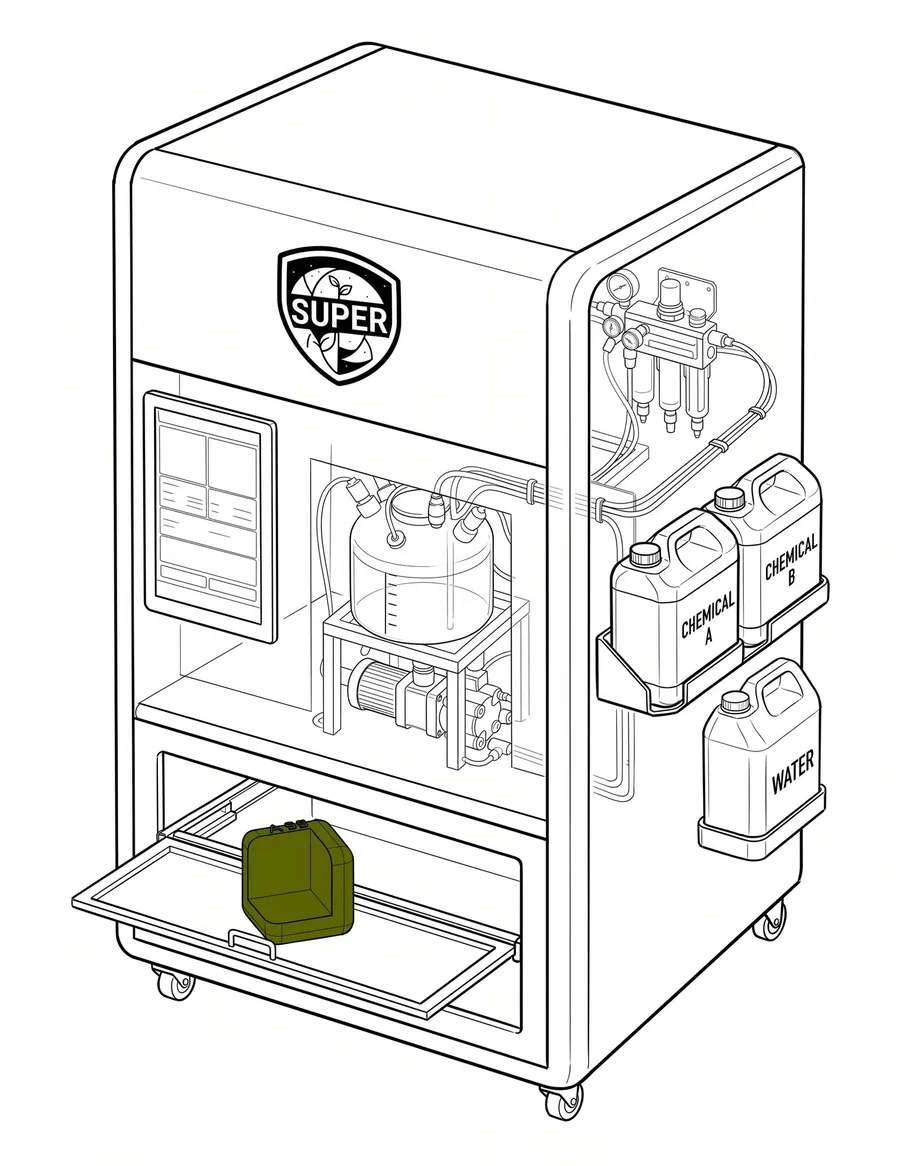 Patent pending
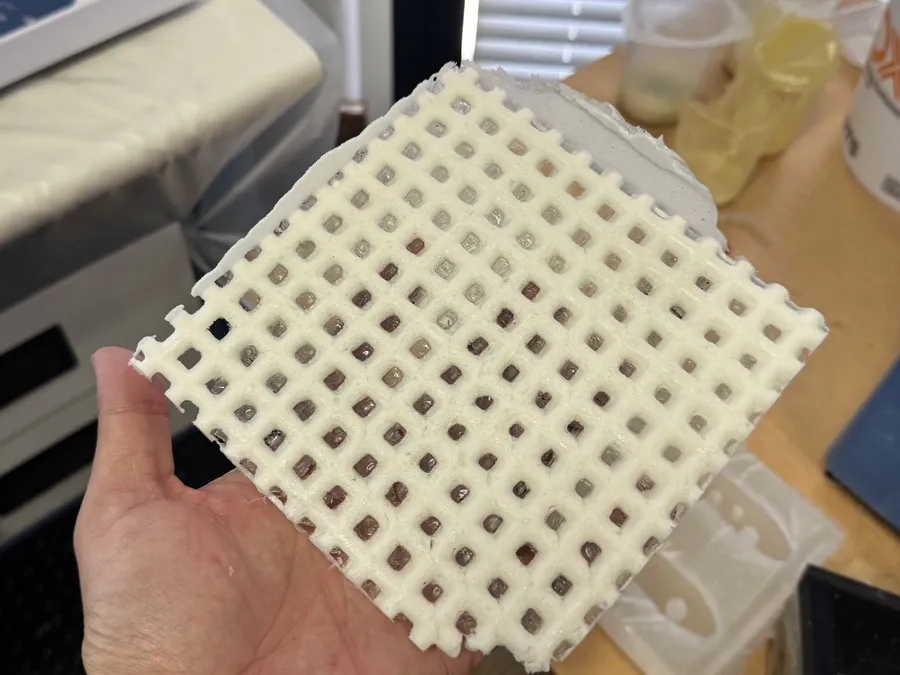
Geometry / In development
Geometry tunes how the part fits and behaves
Cored sections, lattices and surface features change stiffness and vibration response without changing the formula. This work is running in our lab and moving toward production tooling.
Formulation is available for production today. Geometry tuning is offered case by case while it is in development.
- Formulation
- Available
- Geometry tuning
- In development
- Starting point
- Your load case
For hardware teams
Built for hardware teams.
Impact and vibration parts tuned to your load case, without the cost of a traditional custom-material program. Your formulation and shape combination is your IP, not ours.
What to bring
What we need to spec your part
The hardware
The part, its mass, mounting points and the envelope it has to fit. CAD helps if you have it.
The environment
Impact energy, vibration, temperature range, charge, flame and contact requirements.
The targets
Peak force or g limit, stroke, weight budget, or the standard you need to pass. Rough numbers are fine.
The timeline
Exploring, prototyping, planning production or already in production.
Next step
Send the load case. We will spec the part.
No chemistry vocabulary required. Share what you know today and we come back with a material spec and a simulation plan.